Running Toilet Repair Cost: DIY vs Plumber (202)
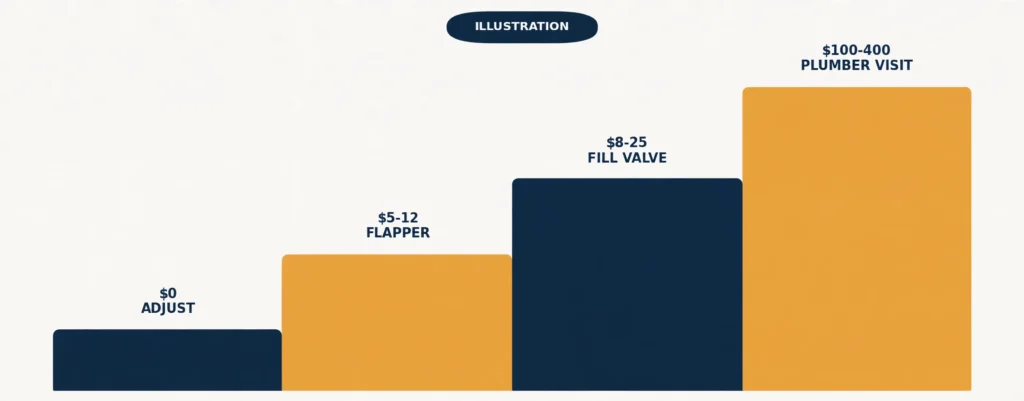
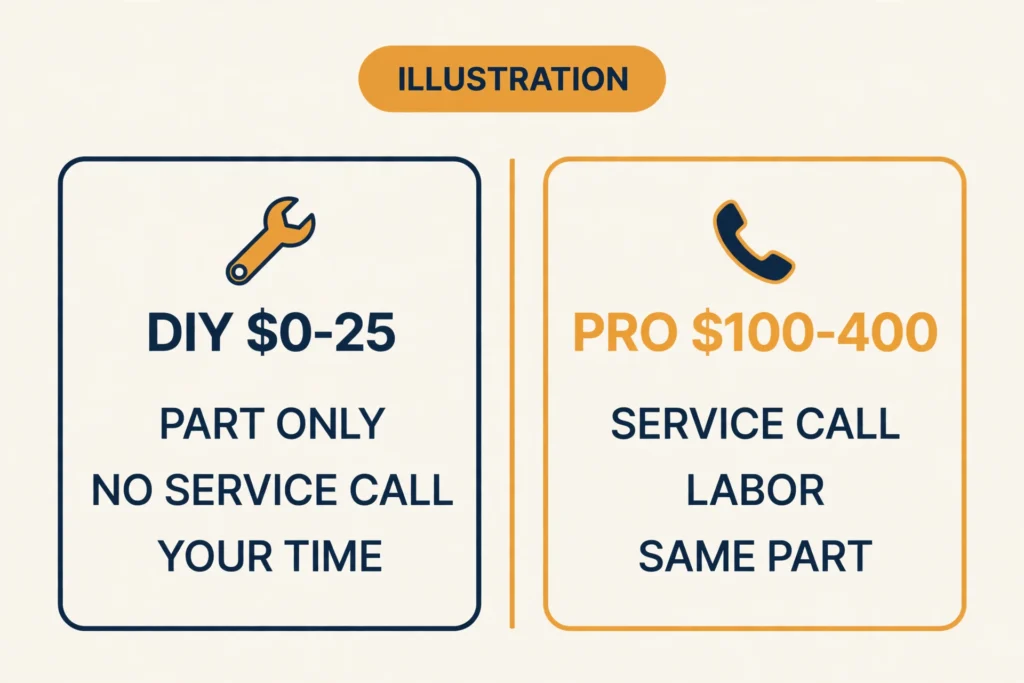
Quick answer: A running toilet costs $0–25 to fix yourself or $100–400 for a plumber visit (2026, US). The DIY number depends on the diagnosis: a tangled chain or bad water level is free, a flapper is $5–12, a fill valve is $8–25. And the leak is costing you: a running toilet can waste up to about 200 gallons a day (a widely cited estimate), $9–15/month on the water bill.
How these numbers work (read this first)
Scope: US national averages, October 2026. DIY = parts only (your time is free; that’s the point). Pro = service call + labor + parts. Every band below is tied to a diagnosis. Because “running toilet” isn’t one repair, it’s four different repairs wearing the same symptom, and the cost difference between them is the whole story.
What’s excluded: the water-bill waste (calculated separately below), any underlying pipe/valve damage found mid-repair, and emergency/after-hours premiums (typically 1.5–3× the standard visit — that’s the industry-standard range, not a quote).
Prices move. Part prices are October 2026 retail spot checks; pro rates vary hard by market (a Manhattan plumber and a Tulsa plumber do not charge the same trip fee). Treat every band as a planning range, not a bid.
DIY cost: what you’ll pay by diagnosis
This is why the diagnosis matters — the fix ranges from free to twenty-five bucks, and guessing wrong just means a second trip to the store:
| Diagnosis | Part | Typical DIY cost |
|---|---|---|
| Tangled chain / bad water level | Nothing — it’s an adjustment | $0 |
| Worn flapper | Universal flapper (Korky runs $5.48–6.98) | $5–12 |
| Bad fill valve | Universal fill valve (Fluidmaster 400A: $9.98 at Home Depot) | $8–25 |
| Whole tank rebuild | Full kit — fill valve + flapper + flush valve + lever (Fluidmaster kit: ~$21) | ~$20–25 |
The pattern: every tank part is cheap, and they’re all 10–30 minute jobs with basic hand tools. The expensive part of a running toilet was never the repair — it’s the diagnosis and the water bill while you put it off. If you haven’t pinned down which part is failing, the 5-minute diagnosis sorts it before you spend anything.
Pro cost: what a plumber charges
| Typical range | |
|---|---|
| Service call / trip fee | $100–250 |
| Hourly labor (after the first hour) | $45–200/hr |
| Typical running-toilet visit, all-in | $100–400 (Angi 2026); $100–300 (Modernize 2026) |
Notice the shape of it: the visit costs $100+ before anyone touches the tank, and the part that actually gets replaced is the same $6 flapper you’d buy yourself. That’s not a criticism of plumbers — you’re buying the diagnosis, the correct part on the first try, and someone else’s liability if the shutoff valve snaps. For a straightforward flapper or fill valve, the DIY savings are 90%+. The pro earns their fee when the shutoff valve is corroded, the toilet is a specialty model, or you’d rather not learn plumbing at 9 PM.
The hidden cost: what the leak itself is costing you
A running toilet isn’t just annoying — it’s a meter running. The widely cited figure is up to 200 gallons a day for a toilet that never stops (via a plumber blog citing the EPA). The number is real, the attribution chain is secondhand, so treat it as an upper bound, not a promise.
What does that mean in dollars? Worked example, assumptions stated:
- 200 gallons/day × 30 days = 6,000 gallons/month
- US combined water + sewer rates run roughly $1.50–2.50 per 1,000 gallons in most markets (this is the big variable — some cities are double)
- 6 × ~$1.50–2.50 = ~$9–15/month added to the bill, every month it runs
A slow, intermittent run might be a third of that; a full-bore overflow-tube leak hits the top of it. Either way, the math that matters: the part that fixes it costs less than one month of the leak. A $6 flapper pays for itself in weeks. That’s the real cost argument for fixing it this weekend instead of “getting around to it.”
What moves the price
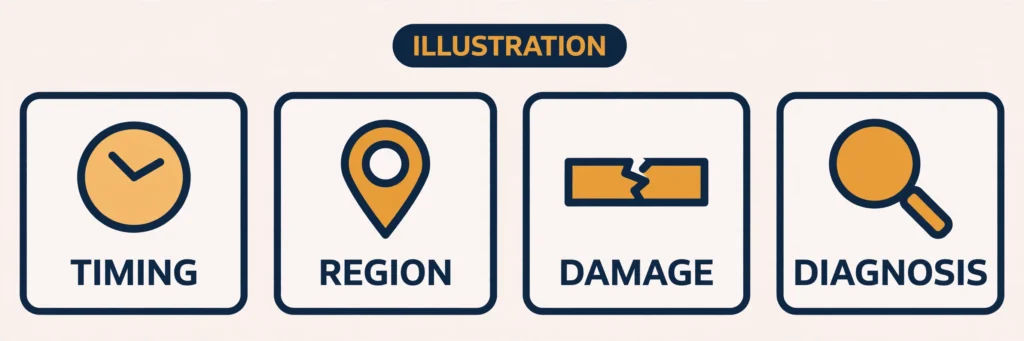
- Emergency timing. Nights, weekends, and holidays run 1.5–3× standard rates. A running toilet is almost never a true emergency — shut the valve at the wall, and it becomes a Monday-morning job at Monday-morning prices.
- Region. Metro trip fees and labor rates run 30–50% above smaller markets. Get the local number, not the national one, when budgeting a pro visit.
- What they find. A corroded shutoff valve, a cracked supply line, or a flange problem discovered mid-visit turns a $150 flapper call into a bigger ticket. This is the honest reason pro ranges are wide — the toilet is often the messenger, not the whole problem.
- Your diagnosis accuracy (DIY). The $5 fix becomes a $25 fix when you buy the flapper, then the fill valve, then the kit. Diagnose first (the 5-minute diagnosis), buy once.
DIY or pro? The actual decision
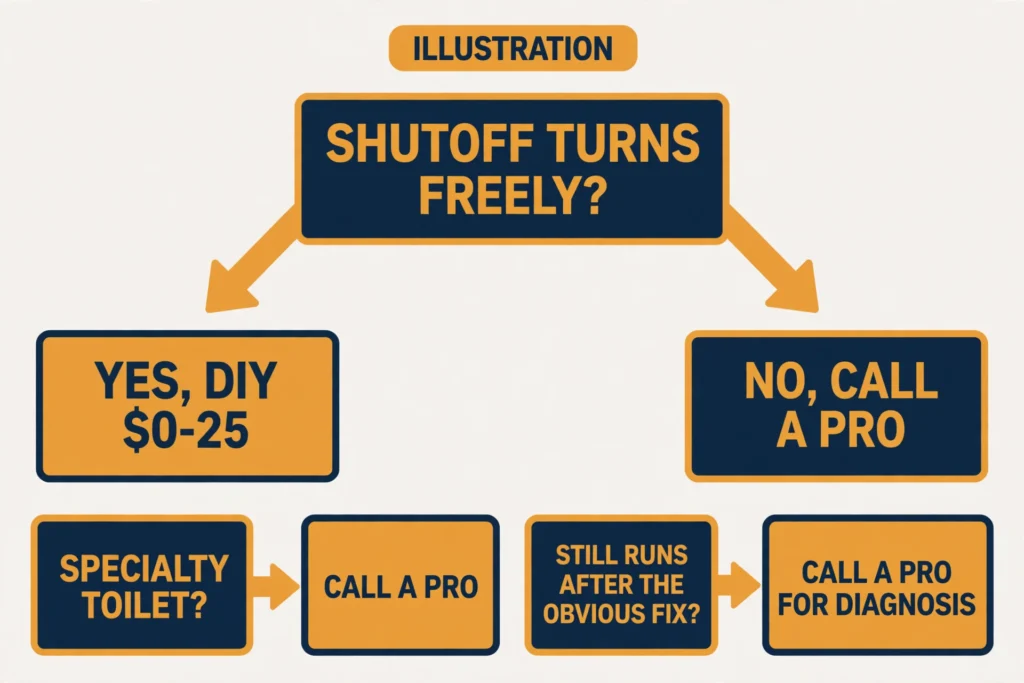
DIY it when: it’s a tank-internal part (chain, flapper, fill valve), the shutoff valve at the wall turns freely, and the toilet is a standard two-piece. Total risk: ~$20 and an hour.
Call a pro when: the shutoff valve is corroded or seized (the #1 thing that turns a DIY job into a flood). Water is coming from anywhere except the tank internals, the toilet is wall-hung or an integrated smart unit. Or you’ve replaced the obvious part and it still runs — at that point you’re paying for diagnosis, not parts.
The middle path: buy the part, try the 20-minute fix, and keep a plumber’s number handy. A running toilet gives you this luxury — it’s a problem you can attempt without committing, because shutting the water off pauses the whole situation.
Don’t overpay for this
- Don’t pay emergency rates for a non-emergency. Close the shutoff valve. The toilet can wait until business hours, and the price difference is real money.
- Don’t approve a “while I’m here” rebuild you didn’t ask for. A running toilet needs one part, not a $400 tank renovation. Ask what the diagnosis is and what the part costs before authorizing extras.
- Don’t buy the part twice. The dye test (Day 2) costs nothing and tells you flapper vs fill valve before you spend a dollar. The most expensive DIY repair is the one you do twice.
- Don’t ignore the water bill math. The $6 part vs $9–15/month leak is the whole argument — “I’ll get to it” is the most expensive option on this page.
FAQ
How much does a plumber charge to fix a running toilet? Typically $100–400 all-in for a standard visit (2026, US), per Angi’s 2026 cost data. Most of that is the $100–250 service call; the part itself is usually under $25.
What’s the cheapest way to fix a running toilet? Diagnose first, then buy one part: a chain adjustment is free, a flapper is $5–12, a fill valve is $8–25. The full DIY range for the common causes is $0–25.
How much water does a running toilet waste? Up to about 200 gallons a day for one that runs constantly — roughly $9–15 a month on a typical water bill. Even a slow intermittent run adds up; the fix always costs less than the leak.
Is it worth calling a plumber for a running toilet? For a standard flapper or fill valve with a working shutoff valve, DIY saves 90%+ on a flapper fix ($6 vs $100+). The plumber earns it when the shutoff is seized, the toilet is a specialty model, or the obvious fix didn’t work and you need a real diagnosis.
Why do plumber quotes for this vary so much? Trip fees and labor rates vary 30–50% between markets, and the range covers everything from “tightened a chain in 10 minutes” to “found a corroded valve and replaced it.” Ask for the diagnosis and the part cost separately.
Can a running toilet wait? The toilet can — close the shutoff valve and it stops costing you money immediately. But don’t let it run: every month of leaking costs more than the part that fixes it.
The short version
A running toilet is a $0–25 DIY fix or a $100–400 plumber visit, and the difference is almost entirely the service call. The parts are the same cheap ones either way. Diagnose first (it’s free), buy one part, and fix it this weekend: the leak is costing you $9–15 a month until you do. For the diagnosis walkthrough, start with the 5-minute running-toilet guide; for the procedures, the flapper swap and the fill-valve adjustment.
Part of our plumbing repairs cluster — the full cost picture for a running toilet, DIY versus pro.
Sources
- Angi — How Much Does Toilet Repair Cost in 2026?
- Modernize — Toilet Repair Cost (2026)
- Home Depot — Fluidmaster 400A $9.98
- DealNews — Fluidmaster Pro Series fill valve $11.98
- JustAnswer — plumber thread (Korky flapper Ultra $6.98 / Premium $5.48)
- DealNews — Fluidmaster 2″ universal repair kit $21.23 (Oct 2026)
Last verified: October 2026.