How to Unclog a Shower Drain
How to Unclog a Shower Drain
Quick answer
Most shower drains clog with hair and soap at the strainer, and a $5 plastic zip tool clears them in five minutes. Diagnose first: a slow drain is local, standing water means a plug at the trap, and several fixtures failing together is a vent or main-line job. Work the ladder in order, and do not pour chemicals down a drain that is already blocked.
Is it the drain, the vent, or the main line?
Water that will not go away is a drain problem. Water that will not come out right is a valve problem.
Shower Valve Replacement: The Complete Homeowner’s Guide
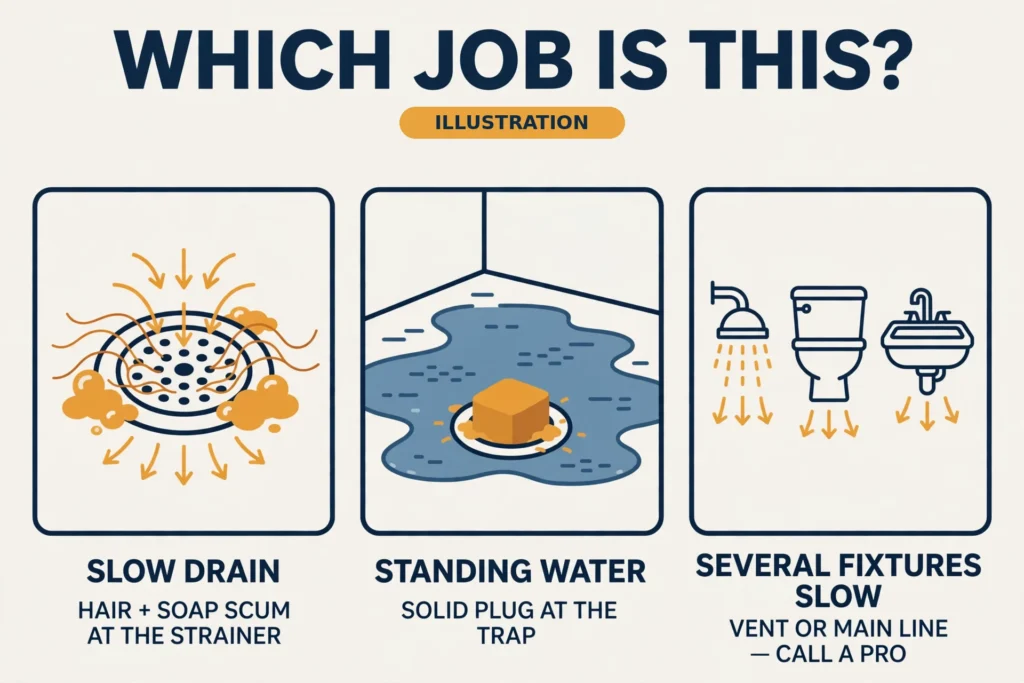
Diagnose before you touch a tool. A slow drain, standing water, and several fixtures failing together are three different jobs.
| What you see | What it usually means | Where the clog is | What to do |
|---|---|---|---|
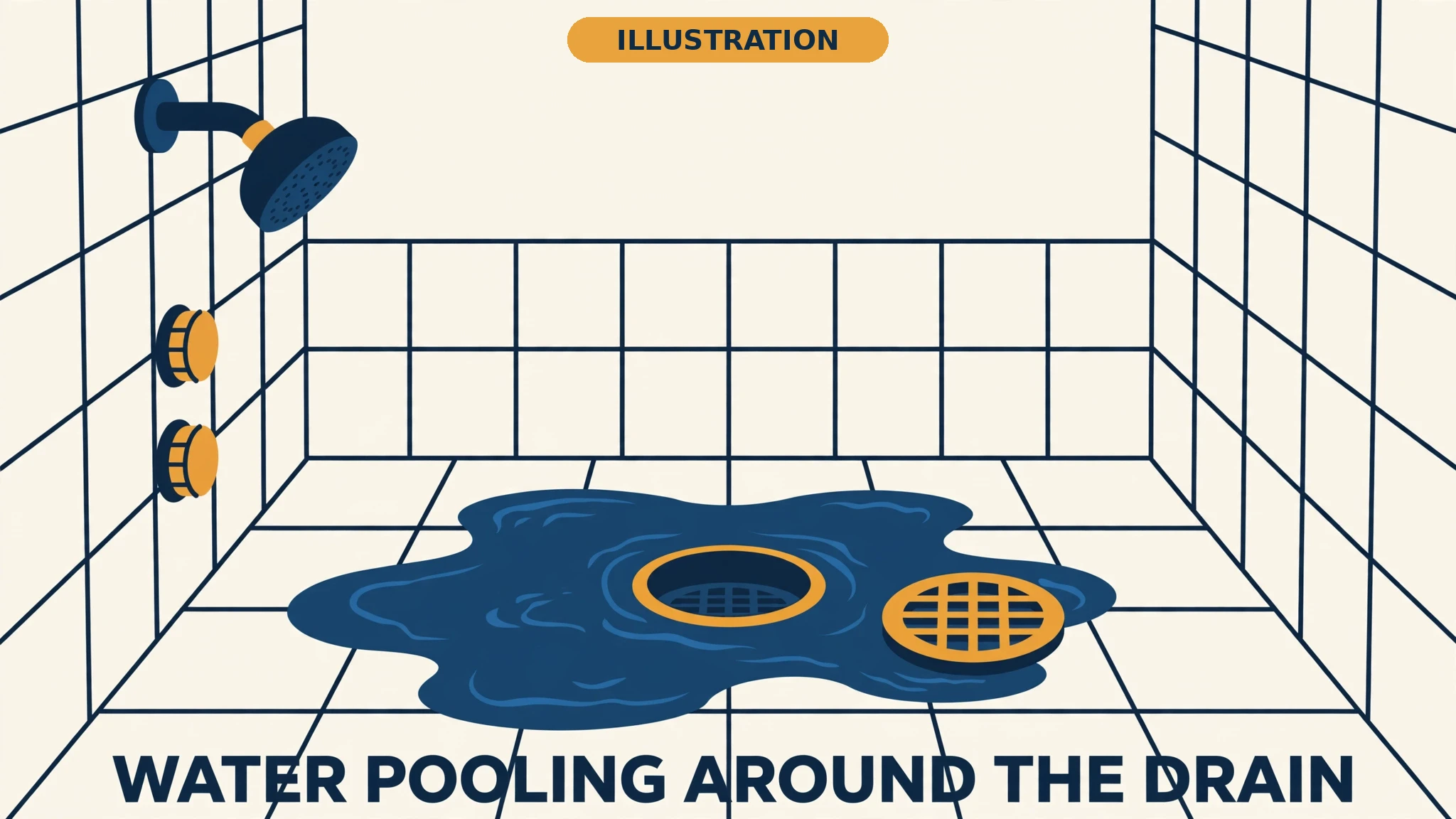
| Water drains, but slowly; it pools around your feet by the end of the shower | Hair + soap scum narrowing the strainer/trap | At the strainer or in the trap, 1–3 ft down | DIY: steps 1–7 below. Start with the strainer and zip tool. |
| Water stands in the shower and does not drain at all | Solid hair/soap plug at or just past the trap | Trap or trap arm | DIY first: bail the standing water out, then plunger → snake. If the snake comes back empty and the water still stands, call a pro. |
| The shower is slow AND other fixtures are slow or gurgling (toilet gurgles when the washer drains, sink bubbles) | Vent-stack blockage or a developing main-line blockage — NOT this drain | Vent stack or shared branch/main line | Do NOT keep snaking the shower. Pro with a camera inspection. |
| Water backs up into the shower or tub when another fixture runs, or sewage smell / sewage in the lowest fixture | Main sewer-line blockage | Main line | Pro immediately. Do not attempt sewage cleanup yourself. |
| The same shower clogs again days after you cleared it | Deeper blockage, pipe buildup, or a partial main-line problem the snake only punched through | Past the trap | Pro with camera ($100–$300); snaking again treats the symptom. |
| Water drains slowly only after heavy rain / the whole house is affected | Main line or septic (full tank / failing drain field) | Outside the house | Pro. Septic owners: check the tank first. |
Two rules to remember. One fixture slow means a local clog. More than one fixture affected means a shared line. And gurgling from a drain you are NOT using means air is being forced past a blockage somewhere else.
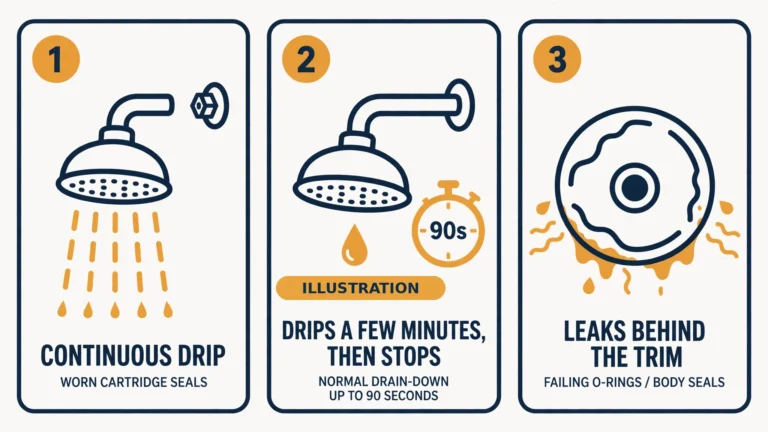
One symptom readers confuse: water dripping FROM the head is a valve or cartridge problem. Water not draining AWAY is this article.
How to Fix a Leaking Shower Head
Before you begin
Tools: cup (flat-bottom) plunger, barbed plastic zip tool (Zip-It / Drain Weasel, ~$5), 25-ft hand-crank drum auger (1/4-in. cable), wet/dry vacuum (optional, if you own one), flathead screwdriver, bucket, damp rag, petroleum jelly.
Materials: rubber gloves, safety goggles, old toothbrush, hair catcher for prevention.
No water shutoff is needed. The shower’s water supply is not touched at any step. That is worth saying explicitly, because the hub and the faucet guide both start with shutting the water off. Here, you do not.
No permit is needed to unclog a shower drain. It is fixture maintenance, not pipe work. If the pro finds a broken pipe or a collapsed line, that repair may need a permit — that is the plumber’s job, not this article’s.
If yours is a tub, not a shower stall, use the tub method. A tub drain has an overflow plate, and the snake goes through it. This article is for shower-stall drains only, and it never uses the overflow route.
[LINK → How to Unclog a Bathtub Drain: the overflow-plate method, pop-up stoppers, and the tub’s trap.]
The ladder, step by step
Work top-down, cheapest and least invasive first. Stop at the step that clears it. Test with running water for a full minute before moving on.
Step 0 — Diagnose first (2 minutes, no tools)
Use the table above. If more than one fixture is affected, skip to the pro decision. Do not start with chemicals under any symptom.
Step 1 — Clear the strainer (5 minutes)
Remove the drain cover. Unscrew it, or pry gently with a flathead screwdriver. Pull out every visible hair and soap clump by hand (gloves on) or with the zip tool. Do NOT push the hair further down. Rinse the cover.
Test the drain. This alone fixes most shower clogs. Hair and soap scum within a few feet of the drain cause nearly all bathroom clogs.
Step 2 — Hot-water flush (5 minutes)
Run very hot tap water for a few minutes. This softens soap scum only.
Do not pour boiling water down a PVC drain. PVC drain pipe has a working limit of 140°F. Boiling water is 212°F. If you know the pipe is metal, a kettle of boiling water in stages is acceptable. Boiling water does nothing to hair. If the clog is hair, this step will not fix it.
Step 3 — Baking soda + vinegar: maintenance only, NOT a clog fix
One-third cup of baking soda, then one-third cup of white vinegar, then a hot-water flush. The honest position: this is not a clog fix. The reaction produces water, carbon dioxide, and sodium acetate. It does not dissolve hair, and it barely touches thick grease. Use it to freshen a drain and loosen surface soap film AFTER the physical clear, or as a weekly maintenance rinse. That weekly use is its legitimate role. Repeating it five times will not change a hair clog.
Even Google disagrees with itself on this one. Its AI answer recommends the mix. Its own People Also Ask answer, citing The Spruce, says it is “largely ineffective and can cause unexpected plumbing problems.” The chemistry sources side with the second answer. For a standing-water clog, the mix sits on top of the water and never reaches the blockage.
Step 4 — Plunger (5–10 minutes)
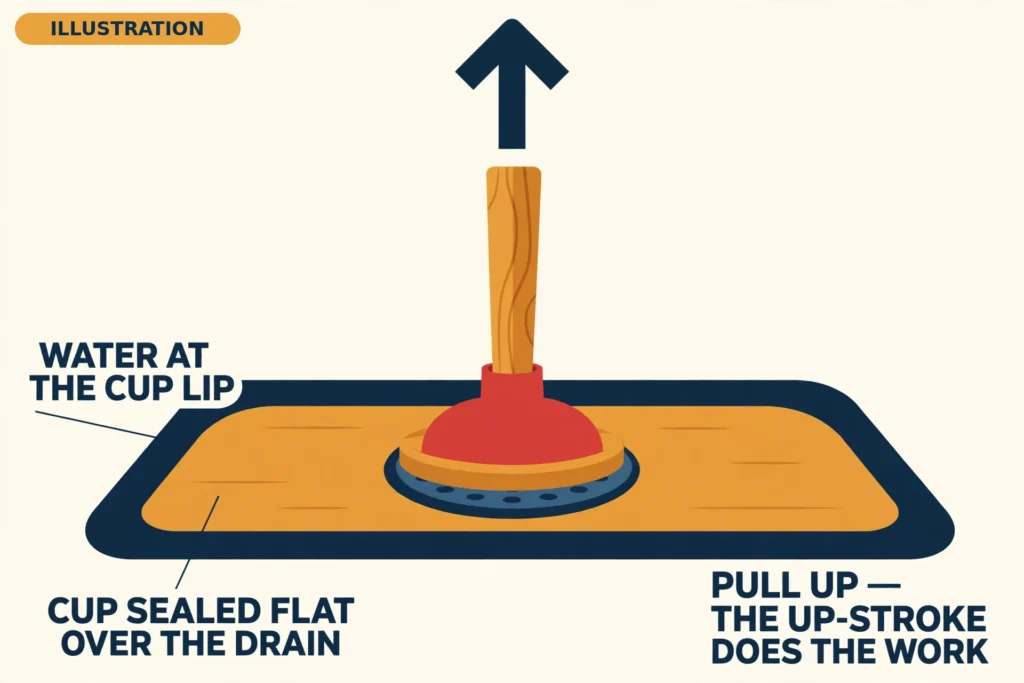
Use a cup (flat-bottom) plunger — the kind for sinks, tubs and showers. NOT a flange/toilet plunger. The two are not interchangeable. Remove the drain cover.
Smear petroleum jelly around the cup rim if the seal is poor. Fill the shower with enough water to cover the cup lip. Plunge with quick, firm up-and-down strokes, 10–15 repetitions, pulling up sharply. The pull matters more than the push.
A pro put it plainly:
“Plunging, done properly, can remove 90 percent of clogs.”
Never plunge a drain that has had chemical cleaner poured into it. Caustic splashback burns skin and eyes.
Step 5 — Barbed zip tool / hair snake (5 minutes, ~$5)
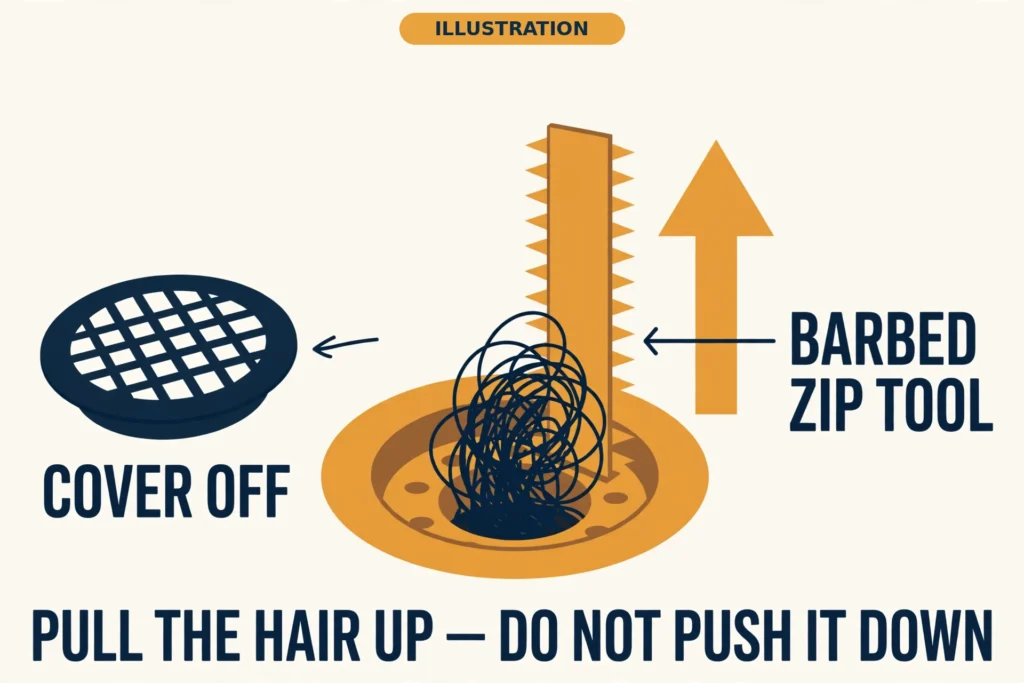
The plastic barbed strip (sold as Zip-It, Drain Weasel and similar) is the highest-value tool for this exact clog. Insert it past the trap, twist, pull out slowly. It hooks the hair mat and brings it up. A multi-pack costs $5–$8. A FlexiSnake Drain Weasel is $10–$15 and 18 inches long.
Do NOT recommend a straightened coat hanger. A $5 zip tool does the same job without scratching the drain finish or pushing the clog deeper. The “Don’t do this” block owns this point.
Step 6 — Drain snake / auger (15–30 minutes)
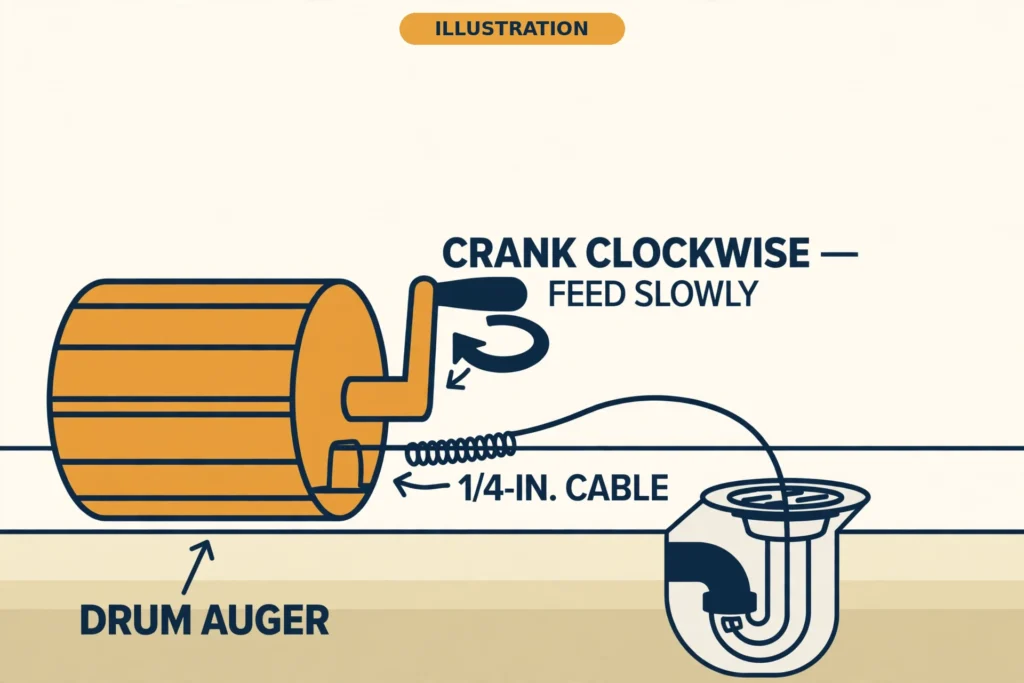
The tool for a clog past the zip tool’s reach. Buy a 25-ft hand-crank drum auger with a 1/4-in. cable, for 1¼–2 in. lines (the shower’s size). It costs $15–$50. A decent homeowner-grade model runs $25–$45.
Do NOT buy a powered machine for a fixture clog. A Milwaukee M12 25-ft kit is $299. The M18 FUEL kit is $603.52. Both are pro-grade and unnecessary here.
How far is the clog? Usually 1–3 ft down. But Home Depot reviewers report clogs usually 5–20 ft down, “not near the P-trap.” The draft states the range honestly. The clog is not always within arm’s reach. That is why a 25-ft cable is the right buy.
Technique: remove the cover. Feed the cable slowly, turning the handle clockwise. Extend 6–12 in. past the drum lock before cranking.
When you feel resistance, work the snake back and forth while turning. The rotation is what hooks or breaks the clog. Retract while continuing to turn, pulling slowly so the hair mat comes out with the cable. Run hot water to confirm flow.
Do not force it. A cable forced around a bend can loop or kink and become unretrievable in a larger pipe. If the cable will not advance, pull back 2 in. and try again while turning.
Shower-specific: feed through the drain opening only. Showers have NO overflow plate. The overflow-plate snake route belongs to the bathtub spoke. Do not import it.
One homeowner learned how deep a clog can sit:
“Experience clogged tub drains three times in the last four years. Had a 25′ snake that I ran down and could find any clogs but still didn’t work. Cost me $278 to have plumber come out and learned that hair in the pipe at 40′ was the problem.”
Step 7 — Wet/dry vacuum, the optional tool (5–10 minutes, $0 if owned)
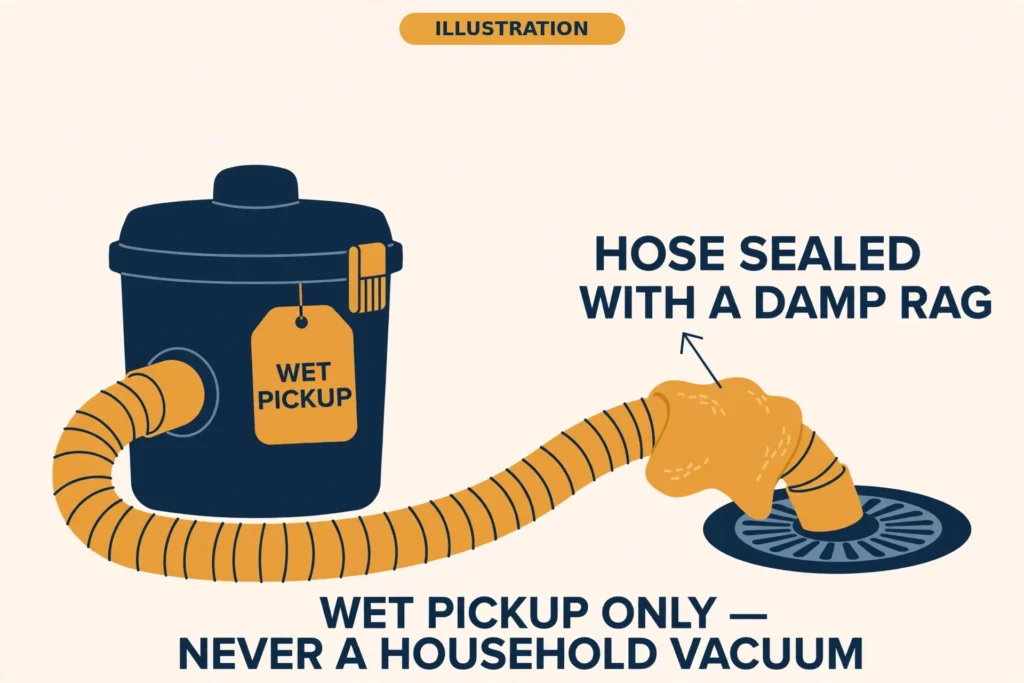
Set the vac to wet pickup and remove the paper filter, or fit the foam sleeve. Remove the drain cover, let a little water build up, press the hose against the drain and seal the gap with a damp rag. Run in short pulses (10–15 seconds, repeat 2–3 times) and pull slowly. The suction lifts the hair mat up the trap instead of pushing it deeper.
Never use a regular household vacuum on water. Shock risk. Never vacuum right after using chemicals. Splashing.
Why it works especially well on showers: there is no overflow opening to leak air, so the seal holds. That is a point no ranked guide makes. If you do not own one, a wet/dry vac costs $50 or more — do not buy one for a single clog.
Should I pour chemicals down a shower drain?
Short answer: no. For a hair clog, a $5 zip tool beats a bottle of drain cleaner. This section is not a step. It is the honest box, for readers who will use a bottle anyway.
The three types: caustic (sodium hydroxide/lye — it saponifies, and generates heat); oxidizing (bleach/peroxides); acidic (sulfuric/hydrochloric — rare in consumer products). Enzymatic/bacterial is the fourth type. It is slow (24–48 hrs to work) and maintenance-only. It is too slow to clear a standing-water clog. It is the safest option for pipe health and septic systems.
What the sources agree on:
- Mechanical methods first.
- Chemicals only ever for a single slow (not stopped) drain.
- Exact label dose.
- Never a second bottle.
- Never on a fully blocked drain — the chemical sits and concentrates.
- Never mix products. Acid + bleach makes chlorine gas. Caustic + acid can react violently.
- Never follow with a plunger.
- Never on a septic system — they kill the beneficial bacteria the tank needs.
- Repeated caustic use softens and warps PVC and pits chrome.
- Always tell the plumber what you poured in. Plumbers charge extra after chemicals.
The positions, stated not smoothed over. Richard Trethewey at This Old House:
“Sometimes it’ll actually clear the stoppage, but other times it doesn’t. So now you got all that chemical sitting in the pipe…it’ll rot away the pipe over time.”
One cost guide allows chemicals ONLY on a single slow, not fully blocked, drain. Another source says caustic or oxidizing cleaners are the most effective for an immediate shower clog. It adds that the gentler enzymatic products are the best long-term choice for pipe health. The draft’s line stands: for a hair clog, mechanical beats chemical.
What NOT to use: bleach for clogs (it cleans and sanitises; it is “not always effective on shower clogs”). Hydrogen peroxide + baking soda paste. Acid drain cleaners — burns and fumes in a small bathroom.
If Drano already failed: stop. Do not pour a second bottle. Do not plunge or snake yet. Flush with water and wait 24 hours before trying anything else. Then work the mechanical ladder. And tell the plumber what you poured in.
When it is not this drain
- The snake comes back empty and the water still stands → the clog is past the trap. Pro with a camera.
- The clog returns within days → deeper blockage, pipe buildup, or a partial main-line problem. Pro with a camera.
- More than one fixture is affected → vent stack or main line. Do not keep snaking the shower.
- Gurgling from drains you are not using → air forced past a blockage elsewhere. Pro.
- Sewage smell or any sewage backup → main line. Pro immediately. Do not attempt sewage cleanup yourself.
Vent stack vs main line. The distinction matters, because the pro, the price, and the urgency differ.
A vent stack is a vertical pipe through the roof that lets air into the system. Blocked by leaves, a nest, or ice, it starves the drains of air: slow drainage + gurgling across several fixtures, and sewer odour when traps get siphoned dry. Clearing costs $175–$450 by roof access. Roof work is NOT a DIY step in this article.
A main sewer line is tree roots, a sagging “belly”, scale, or a partial collapse. Signs: slow drains in more than one fixture at once. Gurgling from drains you are not using. Persistent sewage smell. Backups into the lowest fixture. The problem getting worse over weeks.
Fix: camera inspection ($100–$300), then snaking ($200–$600) or hydro jetting ($350–$600). A sewer line issue will not fix itself, and DIY tools cannot reach it. On a septic system, widespread gurgling can mean a full tank or a failing drain field — the tank, not the shower drain, is the job.
What does it cost to unclog a shower drain?
DIY tools (buy once, keep):
| Item | Price |
|---|---|
| Barbed plastic zip tool / hair snake | ~$5; multi-pack $5–$8 |
| FlexiSnake Drain Weasel | $10–$15 |
| Cup plunger | $10–$15 |
| 25-ft hand-crank drum auger (1/4-in. cable) | $15–$50; decent model $25–$45 |
| Hair catcher — silicone/mesh | $3–$8 |
| Hair catcher — DANCO 10306 | $6.98 (Home Depot live price) |
| Hair catcher — TubShroom Ultra (stainless) | $13.99 (Target live price) |
| Enzyme cleaner (maintenance) | $10–$20 per container |
| Full DIY kit (plunger + zip tool + auger + enzyme) | ~$60–$80 total |
Pro drain clearing (2026, US):
| Job | Price |
|---|---|
| Drain cleaning, national average | $246; most pay $147–$352 (Angi, 33,589 verified projects) |
| Bathtub/shower drain clearing | $225 (Angi) |
| Drain cleaning, national range | $186–$549; bathroom sink/shower/tub $150–$225 (Thumbtack) |
| Snaking (one drain) | $195 (Thumbtack) |
| Bathroom drain cleaning | $100–$225 per drain, avg ~$150 (ABSPipes) |
| Hydro jetting | $350–$600, avg $475 (Angi); up to $1,000 complex (Thumbtack) |
| Camera inspection | $100–$300 (ABSPipes); $175–$350 (contractor); up to $600 with a full diagnostic |
| Vent-stack clearing | $175–$450 (single regional source) |
| Emergency (nights/weekends) | $200–$500+ vs $100–$250 standard hours |
Conflicts, stated not averaged: the national average is Angi’s $246 (all drains) against ABSPipes’ bathroom average of ~$150 — different scopes, quoted with their scopes. Tub/shower clearing is Angi $225 against ABSPipes $150 against Thumbtack $150–$225. The draft gives the band and says local quotes decide.
Hydro jetting is $350–$600 (Angi/Thumbtack) against $350–$800 (ABSPipes). Camera inspection is $100–$300 against $175–$350 against $200–$600 — different definitions, from a quick look to a full diagnostic with a report. The vent-clearing band of $175–$450 has one regional source only. The draft says so.
The honest money line: a $5 zip tool plus a $25 auger, against a $225 pro visit. And the prevention payoff, from a homeowner:
“Well worth the small cost. Will save me alot down the road for not having to call a plumber.”
Don’t do this
- Don’t use a straightened coat hanger. A $5 zip tool does the same job without scratching the drain finish or pushing the clog deeper.
- Don’t pour boiling water down a PVC drain. PVC has a working limit of 140°F. Boiling water is 212°F. Boiling water does nothing to hair anyway.
- Don’t plunge or snake right after chemicals. Caustic splashback burns skin and eyes.
- Don’t mix cleaners. Bleach + acid or ammonia makes chlorine gas. Caustic + acid can react violently.
- Don’t pour a second bottle if the first did not work. Flush with water and wait 24 hours.
- Don’t use a household vacuum on water. Shock risk. Wet/dry vacuum only.
- Don’t force the snake. A kinked cable can become unretrievable. Pull back 2 in. and try again while turning.
- Don’t feed a snake through a shower’s “overflow.” There isn’t one. That route belongs to the bathtub spoke.
Call a pro when
The snake comes back empty and the water still stands. The clog returns within days. More than one fixture is affected. You hear gurgling from drains you are not using. There is a sewage smell or any sewage backup. The house is on septic and the tank may be full.
Prevention — the $5 fix
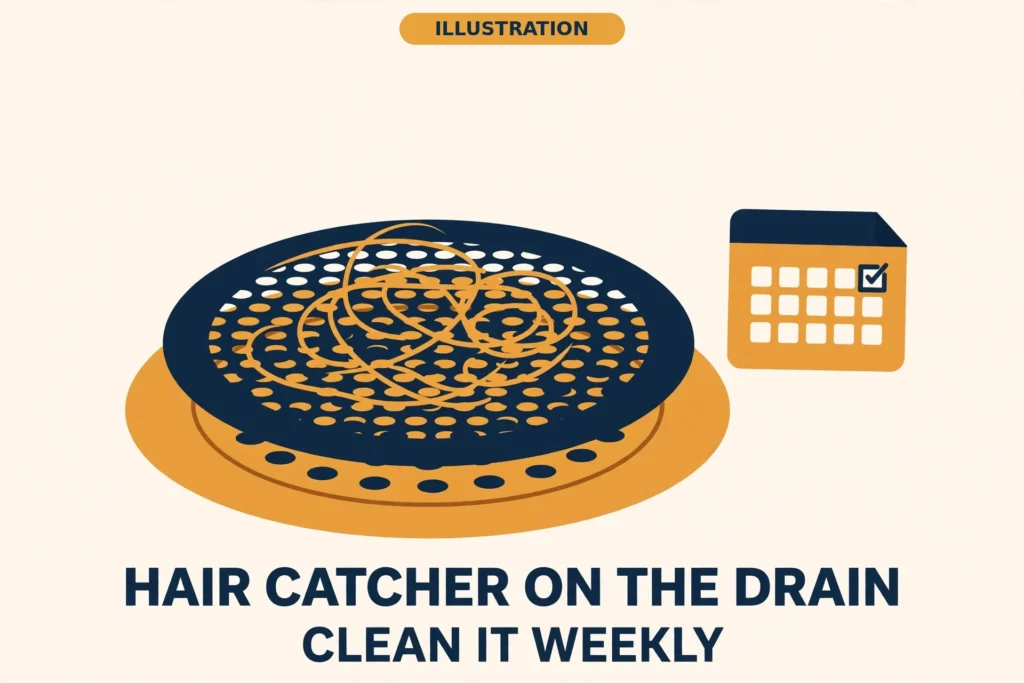
A hair catcher is the cheapest plumbing in the house. Silicone or mesh catchers cost $3–$8. The DANCO 10306 is $6.98 at Home Depot. The TubShroom Ultra in stainless is $13.99 at Target. Clean it weekly. Bob Vila’s author uses a TubRing and notes it “does a nice job of catching hair without blocking the flow of water.”
One honest limit, from a homeowner:
“To be realistic, there isn’t a single strainer / hair catcher out there that will catch every single hair that drains without restricting water flow and clogging up the drain.”
No catcher is perfect. But a catcher plus a weekly baking-soda-and-vinegar rinse — the mix’s legitimate role, maintenance — keeps most showers from clogging at all.
The short version
Diagnose first: slow drain is local, standing water is a plug at the trap, several fixtures failing together is a vent or main-line job. A $5 zip tool clears most shower clogs in five minutes. A cup plunger, then a 25-ft hand auger, then a wet/dry vac — in that order. Baking soda and vinegar is maintenance, not a clog fix. Chemicals are the last resort for a hair clog, never the first. The whole DIY kit is about $60–$80 against a $225 pro visit — unless the snake comes back empty, and then it is a camera and a plumber.
FAQ
Does Dawn really unclog drains?
Dish soap cuts grease, not hair. It can help a minor, grease-caused slow drain when combined with hot water. It will not fix a shower drain, which is usually blocked by hair. A hair plug needs a mechanical tool — the zip tool, the plunger, or the snake.
Why should you never use baking soda and vinegar to unclog a drain?
Because the chemistry does not do what the remedy promises. Baking soda plus vinegar makes water, carbon dioxide, and sodium acetate. It does not dissolve hair, and it barely touches thick grease. It freshens a drain and loosens surface soap film. Use it as a weekly maintenance rinse, after the physical clear — not as the fix.
What will dissolve hair in a shower drain?
Nothing safe that you can pour down it. Caustic and acid cleaners can attack hair, but they also attack pipes, and they do not belong in a shower drain. Plumbers use mechanical tools first: a plunger, a drain snake or auger, and hydro jetting. For a homeowner, the honest answer is the $5 zip tool.
Does pouring boiling water down a shower drain help unclog it?
It can melt soap scum and body oils. It will not clear hair. And on a PVC drain, it is the wrong tool: PVC has a working limit of 140°F, and boiling water is 212°F. Use very hot tap water instead.
My shower didn’t work with Drano. What can I do to fix it?
Stop. Do not pour a second bottle. Do not plunge or snake yet.
Flush with water and wait 24 hours before trying anything else. Then work the mechanical ladder: strainer, plunger, zip tool, snake. And tell the plumber what you poured in if you call one.
Why is my shower drain backing up even though there is no clog?
Because the problem is deeper than this drain. A drain that backs up with no local clog is usually a main sewer-line blockage, a tree-root intrusion, or a plumbing-vent problem. Check whether other fixtures are slow or gurgling. If they are, do not keep working the shower. Call a pro with a camera.
Sources
- This Old House — How to Unclog a Shower Drain — https://www.thisoldhouse.com/plumbing/how-to-unclog-shower-drain
- Family Handyman — How to Clear Clogged Drains (updated 3 Oct 2024) — https://www.familyhandyman.com/project/how-to-clear-clogged-drains/
- Alliance Chemical — Does Baking Soda and Vinegar Unclog Drains? The Chemistry — https://alliancechemical.com/blogs/articles/does-baking-soda-and-vinegar-unclog-drains
- EngineerFix — Are Drain Cleaners Safe for Pipes? — https://engineerfix.com/are-drain-cleaners-safe-for-pipes/
- Miller’s Home Comfort — How Does a Plumber Clean a Clogged Plumbing Vent? (updated 24 Sep 2026) — https://millershomecomfort.com/plumbing/how-does-a-plumber-clean-a-clogged-plumbing-vent/
- Angi — How Much Does Drain Cleaning Cost? (updated 30 Oct 2026) — https://www.angi.com/articles/how-much-does-drain-cleaning-cost.htm?CID=SYN_Time_CloggedSink_060115&entry_point_id=33797117
Last verified: November 2026.