Drywall Repair: The Complete Homeowner’s Guide
Quick answer: Most drywall damage is a cheap DIY fix. A nail hole needs only spackle, a doorknob hole takes a mesh patch or California patch, and holes wider than six inches need a cut-in piece with backing. Primer and texture are what people miss: bare compound leaves a dull spot called flashing, and a small repair runs $10–30 in materials.
What kind of damage is this?
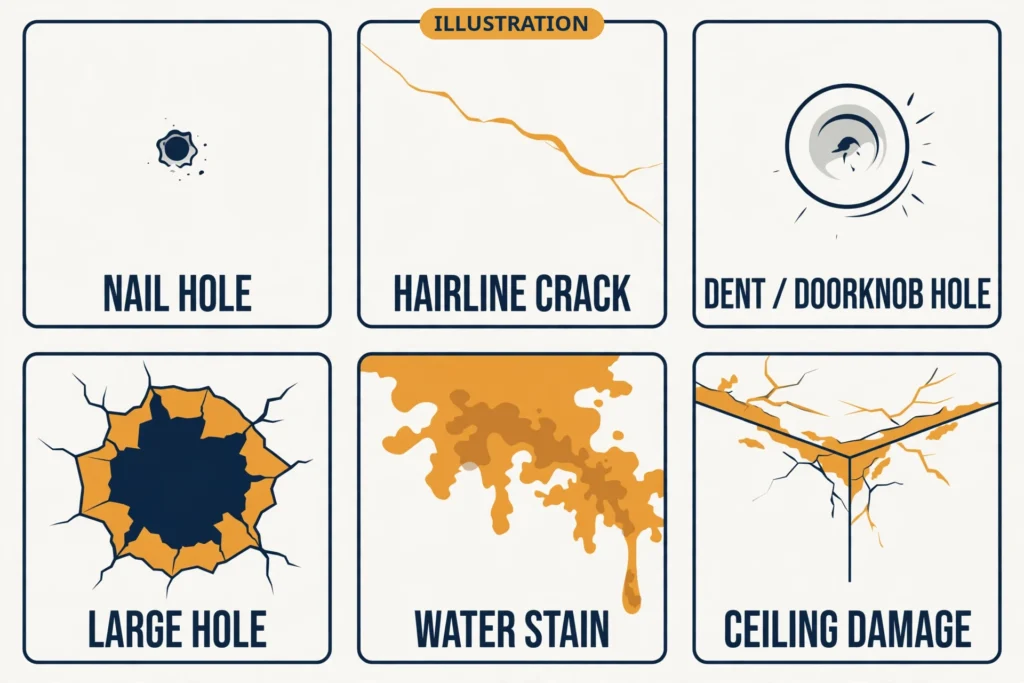
Measure first. The size and the cause pick the method, not the other way round.
| Damage | Size | Your fix |
|---|---|---|
| Nail hole, pinhole | Up to about 1/2 inch | Spackle only |
| Hairline crack | Any length, wall not moving | Tape + compound |
| Dent, doorknob hole | About 1/2 to 6 inches | Mesh patch or California patch |
| Large hole | Over about 6 inches | Cut-in piece with wood backing |
| Water stain, soft or sagging board | Any size | Stop the leak first, then assess — often a pro job |
| Ceiling damage | Any size | Pro in most cases — gravity works against you |
One honest note on the cutoffs: the big guides disagree. Home Depot draws the cut-in line at about 4 inches. This Old House and Lowe’s draw it at about 6 inches. The mesh-patch limit is the same story, about 1 inch per Lowe’s and 1/2 to 1-1/2 inches per This Old House.
When in doubt, go one method up. A stronger method on a small hole costs you ten minutes. A weak method on a big hole costs you the repair.
Before you begin
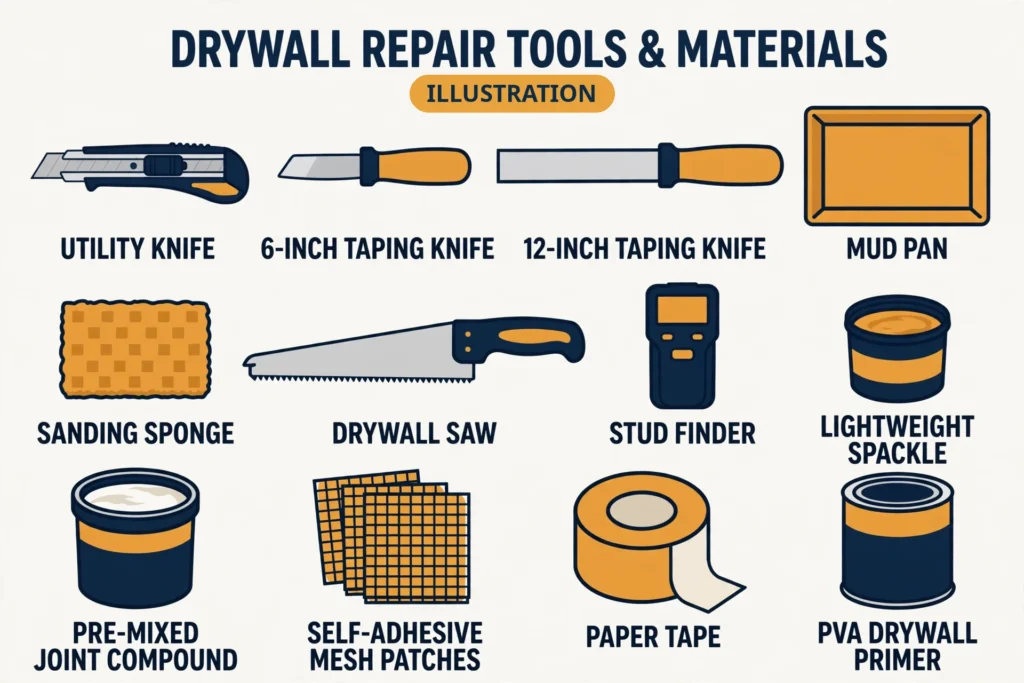
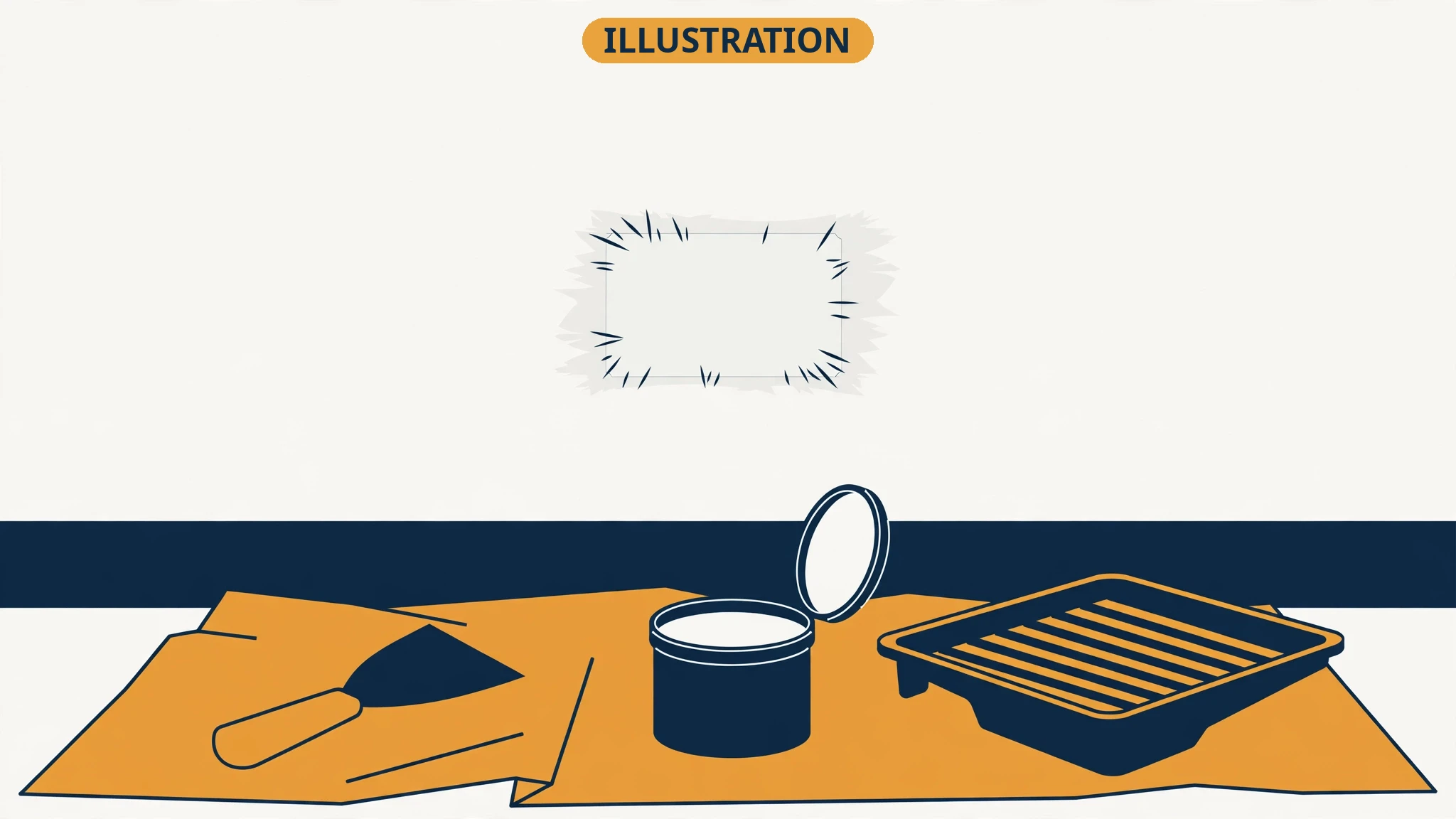
Tools: utility knife, 6-inch and 12-inch taping knives, drywall saw or jab saw, sanding sponge (150–220 grit), mud pan, drill, stud finder, work light you can hold flat against the wall.
Materials: lightweight spackle, pre-mixed joint compound, setting-type compound (“hot mud”) if you use mesh tape, self-adhesive mesh patches, a drywall offcut, 1×3 wood backing strips, drywall screws, paper tape, PVA drywall primer, paint.
Check before you cut. Find the studs. Check for plumbing and wiring behind the cut. If the hole sits over a wire or a pipe, stop.
Safety — read this before sanding anything. Two hazards live in old walls, and both are invisible.
First, lead: in a pre-1978 home, test the paint before you disturb it. The EPA’s renovation rule binds paid work, not a homeowner fixing their own wall. The lead-safe practices still apply to you, though. Test first, contain the dust, wet-wipe, and use a HEPA vacuum. If the test is positive and the job is large, hire a certified firm.
Second, asbestos: joint compound made before about 1982 can contain it, and you cannot tell by looking. Test before you sand or cut old compound. If it comes back positive, stop and call a certified abatement professional.
One more line: the wall between an attached garage and the house is fire-rated, usually 5/8-inch Type X board. Replacing it is a permit job in most places. Cosmetic patching on a standard interior wall almost never needs a permit, but local rules vary. Check with your building department when the wall is fire-rated, shared, or structural.
The size ladder: pick your fix
Nail holes and pinholes — spackle only
- Push a small amount of spackle into the hole with a putty knife. Scrape it flat.
- Let it dry about 30 minutes. Sand it smooth with 150-grit.
- Add one more thin coat if it shrank. Prime, then paint.
Bob Vila puts the through-wall limit for spackle at about 1/2 inch. Past that, spackle has nothing to hold onto. It sags, falls in, or cracks out.
Small to medium holes — mesh patch
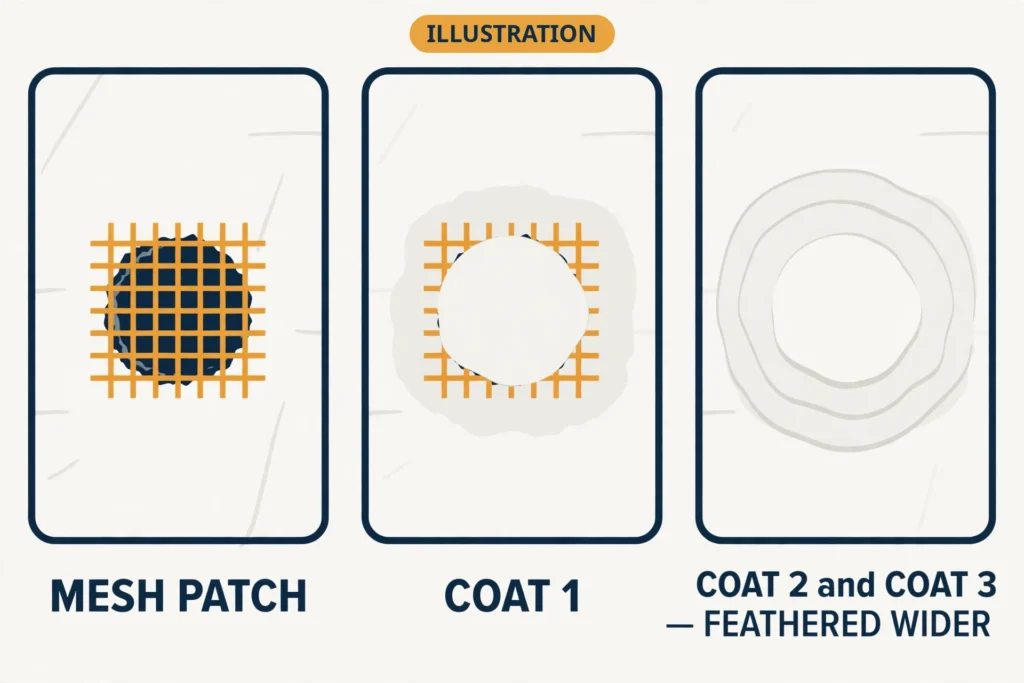
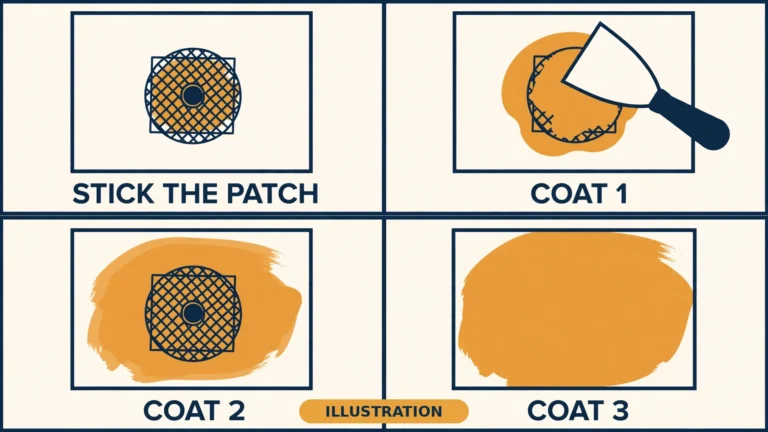
- Clean the edges. Stick a self-adhesive mesh patch over the hole, overlapping the wall by about an inch on every side.
- Spread compound over it in thin coats, feathering wider each time. Three coats is the usual number.
- Let each coat dry fully — 12 to 24 hours for pre-mixed compound, longer in cold or damp rooms. Sand between coats.
- Check your work with a light held flat against the wall. It shows every ridge.
Medium holes — the California patch
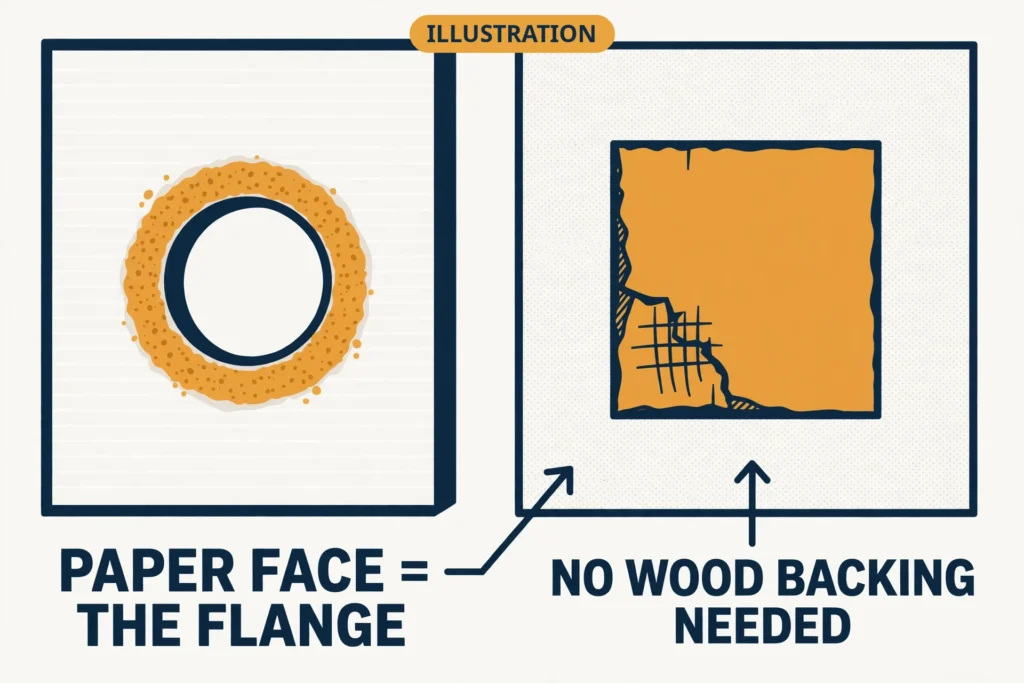
- Cut a drywall piece about an inch larger than the hole on every side. Score the back and snap away the gypsum, leaving the paper face as a flange.
- Spread compound around the hole, press the patch in, and smooth the paper flange into the wall.
- Finish with two or three thin coats, feathering outward.
It needs no wood backing and no tape. The paper is the tape. This is the method for holes too big for mesh but too small to cut back to studs, roughly 1-1/2 to 6 inches.
How to Patch a Drywall Hole: the full step-by-step for every hole size, with illustrations of each method.
Large holes — cut in a new piece
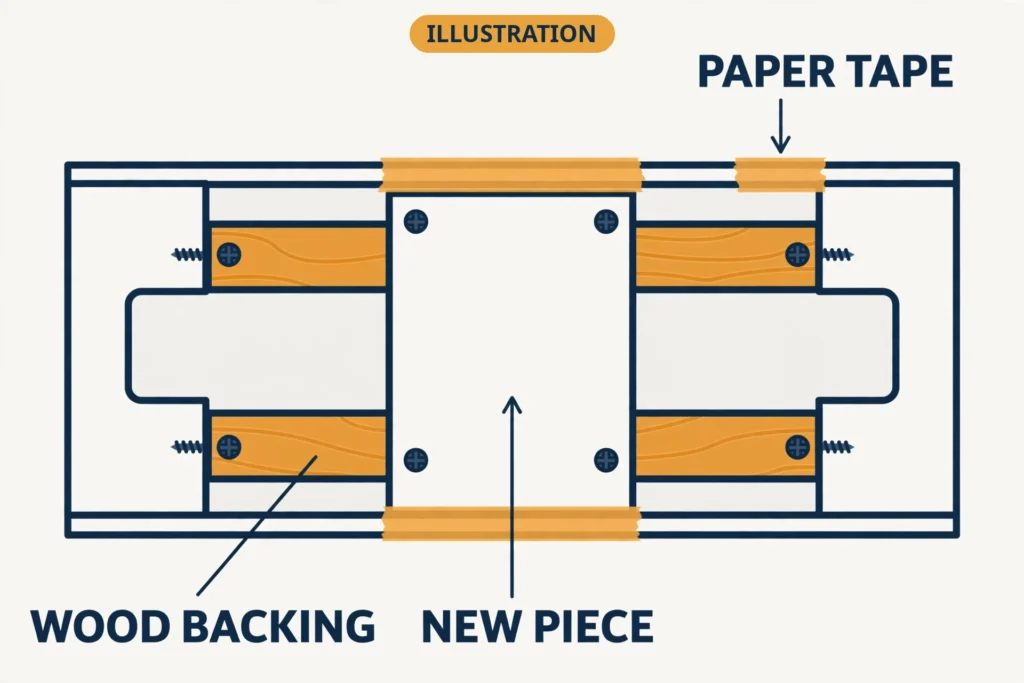
- Square the hole with a utility knife or saw.
- Cut two wood backing strips longer than the hole. Hold them inside the wall and screw through the existing drywall into each end.
- Cut a drywall piece to fit. Screw it to the backing.
- Tape the seams with paper tape and all-purpose compound. Feather three coats, each wider than the last.
This is the method for anything over about six inches, and for any hole where the board is crushed rather than cleanly broken.
Very large holes — cut back to the studs
- Cut back to the centre of the studs on each side. Screw the new piece to the studs.
- Tape and finish as above.
If the opening is wider than about ten inches, frame it properly. At this size, honestly assess whether the pro price is worth your weekend. A pro crew finishes in a day. A first-timer finishes in three, with drying time between coats.
How big of a hole can you spackle?
About half an inch through the wall, and about 1/8 inch deep per coat. Deeper than that, spackle needs multiple thin layers, each drying one to five hours depending on temperature and humidity.
A doorknob hole is the classic case where spackle fails. As one contractor’s repair guide puts it, “a doorknob met the wall, and the wall lost.” The hole is about two inches across with crushed board behind it. Spackle has nothing to grip. Use a mesh patch or a California patch instead.
Do you need to prime a drywall patch before painting?
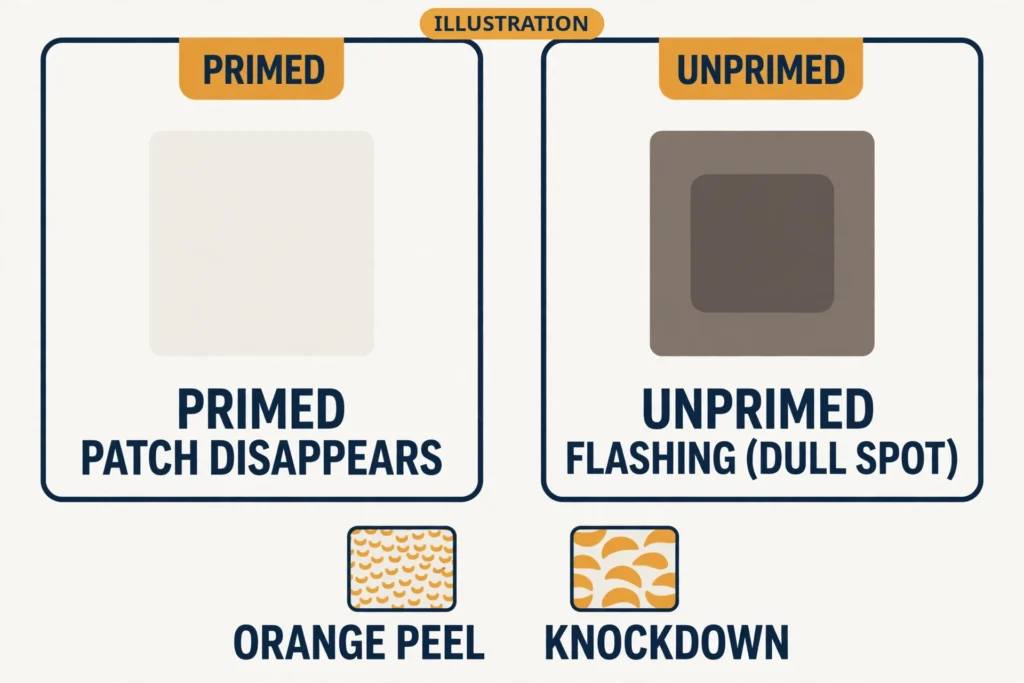
Yes. Always. Bare joint compound is porous. It soaks up paint differently from the painted wall around it. The result is a dull patch called flashing — same colour, different sheen, visible from across the room.
Roll PVA drywall primer over the patch and a little past its edges. Let it dry one to two hours. Then paint corner to corner, not spot to spot. Touch-up paint changes sheen as it ages, so a spot repair in the middle of a wall will show even when the colour matches.
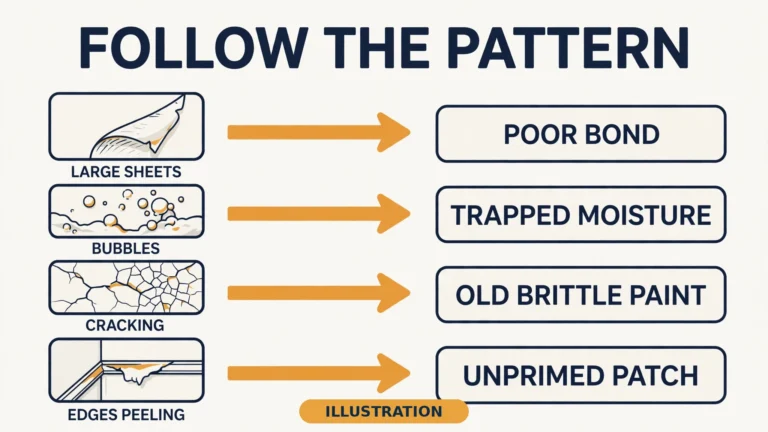
How to Fix Peeling Paint: when the paint itself is the problem, not the wall underneath.
Drying times: the part nobody budgets for
Drying time is where most first repairs go wrong, because every source gives a different number and they are all partly right. Lightweight spackle dries in about 30 minutes. Pre-mixed joint compound needs 12 to 24 hours per coat, longer in cold or damp rooms. Setting-type compound cures chemically instead of drying — 20, 45, 90 or 210 minutes depending on the formula — and you can recoat the same day.
Thin orange-peel texture needs 12 to 24 hours before priming. Heavy knockdown needs 48 to 72. Primer needs one to two hours before topcoat. Latex paint needs about four hours between coats. The rule underneath all of it: thin coats dry fast and flat. Thick coats shrink, crack, and take forever.
Matching the texture
Texture is the hardest part of this job, and the top source of disappointment. The hole is gone. The repair is extremely visible. That is the complaint, in the words of a Los Angeles repair guide, and it is almost always a texture problem, not a patch problem.
First, name what is on your wall. Orange peel is a fine sprayed mist. Knockdown is sprayed, then flattened with a trowel. Smooth walls have no texture at all. Popcorn and slap brush are their own cases.
To match orange peel, thin ready-mix compound to a milkshake consistency and spray it at 30 to 50 PSI. Always test the pattern on cardboard first. Then feather into the existing wall. For a small patch, an aerosol texture can works, but test it on cardboard too — the can’s pattern and your wall’s pattern rarely match on the first try.
Budget an extra $100 to $300 if you hire out texture matching. It is a skill, not a step.
Don’t do this
- Don’t use mesh tape with pre-mixed compound. Mesh tape must be bedded in setting-type compound. Mesh plus pre-mixed is the classic failure combination. It cracks.
- Don’t patch with compound alone and no tape. A taped seam holds. An untaped one cracks. It is a matter of when, not if.
- Don’t lay on one thick coat. Thick coats shrink and crack. Three thin coats, feathered wider each time.
- Don’t skip primer. See flashing, above.
- Don’t spackle a hole with nothing behind it. Spackle is a filler, not a bridge.
- Don’t sand old compound without testing. Pre-1982 walls can hold asbestos. Test first.
- Don’t paint over a patch the same day you mudded it. Wet compound under paint bubbles and peels.
Why does my drywall patch show through the paint?
Almost always flashing: unprimed compound. Prime it, and the patch disappears. If it still shows after priming, check the texture. A smooth patch in an orange-peel wall catches light differently. The fix is texture, not more paint.
And if the patch shows as a crack running through its middle, the seam was never taped. A thin line tracing the patch outline means the tape had too little mud under it. That one needs re-taping, not re-painting.
Why does the same crack keep coming back?
Because the wall is still moving. A crack at a corner or a ceiling joint usually means settlement, seasonal movement, or a framing problem behind the board. Tape and compound hide it for a season. Then it returns.
The fix, in a drywall repair guide’s words, is to “stop the movement, tape the crack for strength, and float it out flat.” If you have patched the same crack twice and it came back both times, stop patching. Find the movement. One contractor reports watching homeowners pay for the same corner three times before someone finally measured the floor. A recurring crack is a diagnosis problem, not a patching problem.
What does drywall repair cost?
DIY materials by size (2026, US):
| Repair | Materials |
|---|---|
| Nail holes | $10–20 |
| Small hole (fist-sized) | $30–60 |
| Medium hole, 6–12 inches | $60–120 |
| Large hole, 12 inches and up | $100–200 |
| Texture matching materials | $40–80 |
A patch kit alone runs $10–30. Tools cost $50–150 if you are buying them new. Expect about $45 in materials for a typical small repair.
Pro costs (Angi, updated September 2026, from 36,945 verified projects):
| Damage | Pro cost |
|---|---|
| Small hole, under about 4 inches | $20–$120 |
| Nail pop | $10–$60 each |
| Cracks | $60–$400 |
| Dents | $60–$200 |
| Water damage | $600–$1,550 |
| Ceiling repair | $320–$1,300 |
| National average, all jobs | $613 (most jobs $296–$930) |
One conflict, stated plainly: Angi says $20–$120 for a small hole, but HomeGuide reports many contractors charging $300–$500 for the same visit. Both are right. The gap is the minimum service call. Most contractors charge $125–$200 just to show up, and some carry a $350–$650 minimum job fee. You are paying for the visit, not the patch. Get the callout fee in writing before you book.
Call a pro when
Water damage you have not traced to its source. A ceiling, where gravity and overhead sanding turn a small job into a miserable one. Cracks that keep coming back after two patches. Any wall that is fire-rated, shared with a neighbour, or load-bearing. Any pre-1978 or pre-1982 wall where testing came back positive for lead or asbestos. And any hole bigger than about a foot across, where a pro crew’s day beats your three weekends.
The short version
Measure the hole, pick the method from the ladder, and go one method up when you are unsure. Thin coats, full drying time, primer before paint, texture tested on cardboard first. The patch itself is the easy part. The finish is the job.
FAQ
How long does drywall mud take to dry between coats?
Pre-mixed compound needs 12 to 24 hours per coat, longer when it is cold or damp. Setting-type compound cures in 20 to 210 minutes depending on the formula, so you can recoat the same day. Spackle dries in about 30 minutes.
Can you paint directly over joint compound?
You can, but you will see it. Bare compound is porous and soaks up paint, leaving a dull spot called flashing. Prime first with PVA drywall primer, then paint.
What size hole needs a new piece of drywall instead of a patch?
Sources disagree: Home Depot draws the line at about 4 inches, This Old House and Lowe’s at about 6. The safe rule is that anything over about six inches, or any hole with crushed board, gets a cut-in piece with wood backing.
How do you fix a crack in drywall so it doesn’t come back?
Tape it, don’t just fill it. Paper tape and all-purpose compound give the seam strength. But if the crack returns after two repairs, the wall is moving, and the movement is the problem to fix.
How much does it cost to repair drywall?
DIY runs $10–$30 in materials for a small repair. A pro averages $613 nationally (Angi, September 2026), with most jobs at $296–$930 — but much of that is the minimum service call, not the patch.
What is the best filler for holes in drywall?
It depends on the size. Spackle wins for nail holes — it dries fast and sands easy. Pre-mixed joint compound wins for patches — it feathers further and shrinks less. Mesh tape needs setting-type compound, never pre-mixed. Buy the filler for your hole size, not the biggest tub.
Is patching drywall hard?
A nail hole is a ten-minute job. A doorknob hole takes an afternoon, mostly drying time. The hard part is the finish — priming and matching texture so the patch disappears. If you can paint a wall, you can patch a small hole. Call a pro for ceilings, water damage, or a crack that keeps coming back.
Sources
- USG — Surfaces and Finishes: How-To Repair Guides (California patch, holes about 6×6 inches and under) — https://assemblies-tools.usg.com/content/usgcom/en/blog/usg-surfaces-and-finishes-repair-how-to.html
- EPA — Lead Renovation, Repair and Painting Program — https://www.epa.gov/lead/lead-renovation-repair-and-painting-program
- Home Depot — How to Patch and Repair Drywall (updated May 2025) — https://www.homedepot.com/c/ah/how-to-patch-and-repair-drywall/9ba683603be9fa5395fab90db38ddbf
- Bob Vila — How to Patch Drywall: Small, Medium, and Large Hole Repair (updated April 2025) — https://www.bobvila.com/articles/how-to-patch-drywall/
- Angi — How Much Does Drywall Repair Cost? (updated September 2026) — https://www.angi.com/articles/how-much-does-drywall-repair-cost-small-holes.htm
- LegalClarity — Do You Need a Permit to Replace Drywall? — https://legalclarity.org/do-you-need-a-permit-to-replace-drywall/
- Peerless Environmental — Asbestos in Drywall Years — https://peerlessenvironmental.com/resources/asbestos-in-drywall-years
Last verified: November 2026.